
Effluent Treatment Plant For Automobile Industry
The automobile manufacturing industry makes extensive use of water for metal finishing, painting, washing, machining, coating, and component cleaning activities, among others. The aforementioned activities create effluents that contain contaminants like oil and grease, heavy metals, suspended solids, chemicals, detergents, and others. It is imperative for automobile manufacturers to install an efficient Effluent Treatment Plant for the Automobile Industry in order to treat such wastewater for environmental and regulatory reasons.
Unistar Aquatech Private Limited specializes in designing and supplying Effluent Treatment Plants for the automobile industry in India. We offer state-of-the-art facilities that can help automobile manufacturers meet their water treatment requirements.
ETP Plant For Automobile Industry
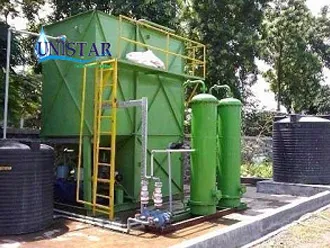
An ETP plant for automobile industries is designed to purify wastewater used during the production of automobiles and its components. The purification process entails several steps, including oil and grease removal, chemical treatment, biological treatment, filtration, and disinfection. The main purpose of using an ETP is to eliminate pollutants from the wastewater in such a way that the water becomes either useful for reuse or safe for disposal. Using an efficient treatment plant, automobile industries can save considerable amounts of money by using less freshwater.
Sources of Wastewater in Automobile Industries
Automobile manufacturing facilities generate wastewater from various operations, including:
- Vehicle washing and cleaning
- Paint booth operations
- Metal surface treatment
- Electroplating processes
- Degreasing and machining activities
- Cooling tower blowdown
- Component manufacturing units
- Floor washing and maintenance activities
These wastewater streams often contain oils, lubricants, solvents, chemicals, phosphates, and heavy metals that require specialized treatment.
Key Features of Automobile Effluent Treatment Plant
A modern automobile effluent treatment plant is designed to handle complex industrial wastewater efficiently. Key features include:
- High removal efficiency for oil and grease
- Effective treatment of heavy metals and toxic chemicals
- Automated operation and monitoring systems
- Compact and space-saving design
- Low maintenance requirements
- Energy-efficient performance
- Compliance with CPCB and SPCB norms
- Water recycling and reuse capabilities
Treatment Process of Automobile Wastewater
The treatment process typically includes:
- Collection and Equalization- Sewage produced by various production areas is collected in an equalization tank where the wastewater flows uniformly and contains consistent pollutant levels.
- Oil & Grease Separation- Oil separators are used to remove oils, greases, and lubricants that float on the surface.
- Chemical Processes- Various chemicals like coagulants and flocculants are used to remove solid particles, toxic metals, and other pollutants.
- Biological Process- Biological treatment helps in breaking down dissolved organic pollutants along with reducing the levels of BOD & COD.
- Filtration & Polishing- Filtration process removes any other contaminants left after the previous treatments.
- Disinfection- Finally, the sewage undergoes the disinfection process before discharge.
Benefits of Installing an Effluent Treatment Plant
An efficient Effluent Treatment Plant For Automobile Industry offers several advantages:
- Ensures compliance with environmental regulations
- Reduces freshwater consumption through recycling
- Lowers wastewater disposal costs
- Protects natural water resources
- Improves corporate environmental responsibility
- Enhances operational sustainability
- Reduces pollution-related risks and penalties
- Supports green manufacturing initiatives
| SN | ITEMS | Description | . |
| . | . | Before Treatment | After Treatment |
| 1 | Temperature | 250 C to 350 C | Not exceed 50 C above ambient |
| 2 | Colour | Light yellowish | Colourless |
| 3 | Odour | Present (light) | Nil |
| 4 | pH | NA | 6.5 to 8 |
| 5 | TSS | NA | <30 mg/l |
| 6 | Oil and grease | NA | <10 mg/l |
| 7 | BOD | NA | <30 mg/ltr |
| 8 | COD | NA | 150 mg/ltr |
Effluent Treatment Plant For Automobile Industry in India
There has been an increased need for Effluent Treatment Plants (ETP) for the Automobile Industry in India owing to a heightened focus on sustainable production and environmental compliance amongst automotive producers. With the rising importance accorded to water conservation and wastewater treatment, industries have started investing in highly efficient treatment solutions which ensure optimal performance at reduced costs. We provide customized effluent treatment plant systems for automobile factories, auto components industries, and vehicle assembling industries in India.
Why Choose Unistar Aquatech Private Limited?
Unistar Aquatech Private Limited is a reliable provider of wastewater treatment plants for industrial applications. Thanks to our professionalism, advanced engineering know-how, and unwavering focus on quality, we provide top-of-the-line ETP plants that meet the unique demands of the automobile sector.
We offer:
- Plant design and engineering
- Treatment technology application
- Turnkey projects
- Installation and commissioning
- Operations and maintenance
Our company has a long history in industrial water and wastewater treatment, and we can ensure that your automobile manufacturing facility complies with environmental regulations.
| . | ITEMS/EQUIPMENTS | Quantity |
| A | PRIMARY TREATMENT SECTION | . |
| 1 | Bar screen | 01 No. |
| 2 | Effluent transfer pump | 01 No. |
| 3 | Air blower (for complete aeration system) | 01 No. |
| 4 | Aeration grids | 01 Lot |
| 5 | Packaged treatment unit | 01 Set |
| 6 | Chemical Dosing systems | 03 Sets |
| 7 | Filter Feed Tank | 01 No. |
| B | SECONDARY TREATMENT SECTION | . |
| 1 | Filter feed pump | 01 No. |
| 2 | Dual Media filter | 01 No. |
| 3 | Activated Carbon filter | 01 No. |
| 4 | Filter Feed Tank | 01 No. |
| 5 | Chlorine Dosing system | 01 Set |
| C | OTHER ITEMS | . |
| 1 | Piping and instrumentation | As per P&ID |
| 2 | Treated water storage tank | 02 Nos. |
| 3 | Transfer Pump, 1.5HP | 02 Nos. |
| 4 | Transfer Pump, 7.5HP | 01 Nos. |
| 5 | Control panel and internal cabling | 01 Lot |
All Services