
Effluent Treatment Plant For Rice Mills
Rice mills use large volumes of water during soaking, boiling, and processing of paddy, and generate a corresponding volume of wastewater as a result. This effluent carries organic matter, suspended solids, and pollutants that can cause serious environmental damage if released untreated. As pollution control norms have tightened across India, installing a properly designed Effluent Treatment Plant (ETP) has become essential for rice mills to remain compliant, protect local water bodies, and safely reuse treated water for purposes like floor washing, toilet flushing, and green belt development.
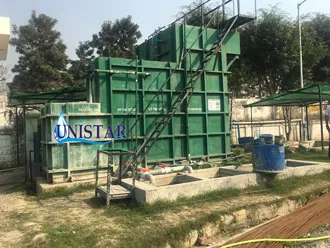
At Unistar Aquatech Private Limited, we design and supply complete ETP systems specifically engineered for the characteristics of rice mill effluent — combining physico-chemical and biological treatment to consistently meet discharge norms.
Why is an ETP Required for Rice Mills?
Rice mill effluent, generated mainly from soaking and pre-treatment rinsing stages, carries organic and inorganic contaminants that are harmful if discharged without treatment. Left untreated, this wastewater can:
- Pollute nearby water bodies and groundwater
- Cause foul odour and discolouration in surrounding areas
- Violate Pollution Control Board (PCB) discharge norms, risking fines or shutdown
- Harm aquatic life due to high organic and suspended solid content
A well-designed ETP brings these parameters down to safe, dischargeable, and even reusable levels — which is exactly what the treatment process below is built to achieve.
Characteristics of Rice Mill Effluent — Before and After Treatment
| SN | Items | Before Treatment | After Treatment |
|---|---|---|---|
| 1 | Temperature | 25°C to 35°C | Not exceeding 5°C above ambient |
| 2 | Colour | Light yellowish | Colourless |
| 3 | Odour | Present (light) | Nil |
| 4 | pH | NA | 6.5 to 8 |
| 5 | TSS | NA | < 30 mg/l |
| 6 | Oil and Grease | NA | < 10 mg/l |
| 7 | BOD | NA | < 30 mg/ltr |
| 8 | COD | NA | 150 mg/ltr |
Since the BOD load in rice mill effluent is fairly evenly distributed across daily discharge, no separate dedicated BOD-removal stage is required — it is handled as part of the standard treatment sequence below.
Treatment Process — How the ETP Works
Our ETP for rice mills follows a sequence of preliminary, primary, secondary, and tertiary treatment stages, each targeting specific contaminants.
1. Preliminary Treatment — Equalization
Effluent arriving from all streams first passes through a bar screen chamber and an oil & grease trap, then collects in an underground equalization tank where it is made homogeneous. Air agitation is provided in this tank to ensure uniform mixing before the effluent moves forward for chemical treatment.
2. Primary Treatment — Chemical Dosing and Clari-Flocculation
- Effluent is lifted and transferred to a flash mixer, where coagulant chemicals are added through automatic dosing pumps for precise, consistent dosing.
- Air agitation in the dosing tanks and flash mixer ensures thorough mixing of the chemical solution; air quantity is regulated through control valves.
- The overflow from the flash mixer moves to the clari-flocculator tank, where a flocculent chemical is dosed to help impurities form large flocs (sludge).
- The clarifier uses an inclined tube-type settler with tubepac media (PVC tubes set at a 60° angle) for efficient sludge separation.
- Sludge settles at the bottom of the tube settler; treated water moves forward to biological treatment.
- Settled sludge is sent to sludge drying beds or a filter press system for dewatering, forming sludge cakes that are disposed of at a landfill or PCB-designated site.
3. Secondary Treatment — Biological Treatment
Water from the secondary tube settler overflows into the treated water holding tank (TWHT) after biological treatment removes dissolved organic matter. Filtered water recovered from the sludge dewatering system is routed back to the equalization tank, minimizing water loss in the process.
4. Tertiary Treatment — Final Polishing
- Water from the TWHT is passed through a Dual Media Filter (DMF) for final removal of TSS.
- It then passes through an Activated Carbon Filter (ACF) to remove residual colour and odour.
- The final treated water is either safely discharged as per PCB norms or reused for horticulture and other on-site purposes.
BRIEF SCOPE OF SUPPLY:-
Our brief scope of supply will include following items for the integrated ETP:
| . | ITEMS/EQUIPMENTS | Quantity |
| A | PRIMARY TREATMENT SECTION | . |
| 1 | Bar screen | 01 No. |
| 2 | Effluent transfer pump | 01 No. |
| 3 | Air blower (for complete aeration system) | 01 No. |
| 4 | Aeration grids | 01 Lot |
| 5 | Packaged treatment unit | 01 Set |
| 6 | Chemical Dosing systems | 03 Sets |
| 7 | Filter Feed Tank | 01 No. |
| B | SECONDARY TREATMENT SECTION | . |
| 1 | Filter feed pump | 01 No. |
| 2 | Dual Media filter | 01 No. |
| 3 | Activated Carbon filter | 01 No. |
| 4 | Filter Feed Tank | 01 No. |
| 5 | Chlorine Dosing system | 01 Set |
| C | OTHER ITEMS | . |
| 1 | Piping and instrumentation | As per P&ID |
| 2 | Treated water storage tank | 02 Nos. |
| 3 | Transfer Pump, 1.5HP | 02 Nos. |
| 4 | Transfer Pump, 7.5HP | 01 Nos. |
| 5 | Control panel and internal cabling | 01 Lot |
Design and Execution Notes
- Wastewater from the pre-treatment plant’s rinsing stages is a continuous-flow effluent, for which chemical treatment is recommended.
- Since the pre-treatment plant is typically at ground level, the bar screen chamber, oil & grease trap, effluent storage tank, and treated water holding tank are installed below ground level — saving on floor space.
- All above-ground tanks are constructed using MSEP (Mild Steel Epoxy Painted) construction.
- Treated water quality after secondary treatment is suitable for reuse in toilet flushing, floor washing, and green belt development, and meets discharge limits prescribed by the relevant pollution control authorities.
- Sludge generated from the ETP is sent to a landfill after proper dewatering, as designated by the Pollution Control Board.
- Our scope of supply begins at the ETP inlet and ends at the outlet of treated effluent.
- Electricity and tap water at the site are to be provided by the client.
- We provide our own water sampling report for the system; third-party sampling, if required, is at the client’s cost.
Why Choose Unistar Aquatech Private Limited for Your Rice Mill ETP
- 25+ Years of experience designing ETPs specifically for agro-industries
- Customized system design based on your mill’s effluent volume and characteristics
- End-to-end support — design, supply, installation, and commissioning
- Get After-sales service, AMC options, and spare parts support details
For a customized quote based on your rice mill’s capacity and effluent volume, +91-9811701883, 8588881234: contact our technical team.
Also Read: