
Sewage Treatment Plant For Hotels
Many hotels today are not connected to a main municipal sewerage system, which makes installing a dedicated Sewage Treatment Plant (STP) essential rather than optional. Hotels generate a significant volume of wastewater daily from guest rooms, kitchens, laundries, and restrooms. A sewage treatment plant — also called a wastewater treatment plant or water pollution control plant — removes most pollutants from this wastewater within a few hours, before it is safely released into the environment or reused on-site.
Proper treatment isn’t just about environmental compliance — it’s essential for maintaining hygiene standards, protecting your hotel’s brand reputation, and supporting long-term sustainability goals.
Unistar Aquatech Private Limited specializes in providing reliable, customized Sewage Treatment Plants for Hotels that meet the specific needs of the hospitality industry — from small boutique properties to large resorts.
Why Do Hotels Need a Sewage Treatment Plant?
The main purpose of an STP for hotels is to treat wastewater influent so that it does not pose a health risk to guests, staff, or the surrounding environment. Wastewater from a hotel is collected and passed through several treatment stages using drains and collectors before it is clean enough to be safely discharged or reused.
Effective sewage treatment plants for small, medium, and large hotels and resorts are compact and combine mechanical, chemical, and biological treatment techniques to minimize water pollution — without requiring large amounts of space or complex operation.
Benefits for Hotels
Using a sewage treatment plant offers multiple advantages for hotels:
- Efficient wastewater treatment and recycling
- Reduced freshwater consumption
- Compliance with pollution control regulations
- Environment-friendly hotel operations
- Lower water procurement costs
- Compact and easy-to-maintain systems
- Long-term operational reliability
- Improved sustainability and brand reputation
Special Features:
- Compact design
- Easy to operate
- Based on latest technology
- Flexibility in handling variation in incoming loads
- Excellent stability characteristics, offering high-quality water for reuse
How Does an STP for Hotels Work? — Treatment Process
Our sewage treatment hotel systems are designed with advanced technologies such as MBBR (Moving Bed Biofilm Reactor), SBR (Sequential Batch Reactor), and MBR (Membrane Bioreactor) to ensure maximum efficiency in treating organic waste, suspended solids, and pathogens. Regardless of the exact technology used, treatment follows four core stages:
1. Preliminary Treatment
This is the first step in processing hotel wastewater, also called mechanical or physical treatment, and it takes place before primary treatment. Incoming wastewater (influent) passes through mechanical bar screens that remove rags, sticks, paper, cans, and other coarse solids. A grit chamber removes sand and grit, and this stage also removes a significant amount of oils and greases — protecting pumps and downstream equipment from damage.
2. Primary Treatment
Also known as physical-chemical treatment, this stage removes organic and inorganic solids through sedimentation and flotation before biological treatment begins. Partially treated wastewater flows through a primary clarifier (sedimentation tank), where the flow slows down to allow heavier solids to settle at the bottom as primary sludge, while floating grease and oil are skimmed off the surface. This stage typically removes about 50–60% of suspended solids and reduces BOD levels by 30–40%.
3. Secondary Treatment (Biological Treatment)
This stage uses biological processes — such as the Activated Sludge Process, MBBR, or SBR — to break down organic matter. Primary effluent enters an aeration tank where it’s mixed with microorganisms and aerated, encouraging bacterial growth that consumes the remaining organic matter. The aerated wastewater then moves to a secondary clarifier, where solids settle out as secondary sludge; part of this sludge is recirculated back to the aeration tank to sustain the biological process. Secondary treatment typically removes about 80–90% of organic solids.
4. Tertiary Treatment (Disinfection)
The final stage removes any remaining suspended or dissolved solids and disinfects the water to eliminate disease-causing microorganisms. This is done using disinfectants such as chlorine, ozone, or UV light. The treated water is now clean enough to be safely discharged or reused for gardening, flushing, cooling systems, and other non-potable applications.
Sewage Treatment Plant (STP) for Hotels in India
The Sewage Treatment (STP plant for hotels) offered by Unistar Aquatech Pvt. Ltd. ensures proper treatment of sewage while maintaining high efficiency. Our plants are designed to work continuously with minimal maintenance and low operating cost. These plants help hotels manage wastewater in a smart way, reducing water wastage and promoting sustainable practices. With our STP solutions, hotels can reuse treated water and save on water bills.
A modern sewage treatment plant for hotels in India helps hotels efficiently manage wastewater while reducing their environmental impact. Unistar Aquatech Private Limited provide advanced sewage treatment solutions specially designed for hotels of all sizes. Our systems are capable of treating wastewater effectively and producing treated water that can be reused for gardening, flushing, cooling systems, and other non-potable applications. This helps hotels reduce freshwater consumption and lower operating costs.
Technical Specification - Sewage Treatment Plant For Hotels
| DESIGN PARAMETER | UNIT | INLET | OUTLET |
| BOD | ppm | 250 | 10 |
| COD | ppm | 550 | 150 |
| TSS | ppm | 150 | 10 |
| Inlet Sewage Flow | M3/Day | 20 | . |
| Operating Hours | Hours | 20 | . |
| Inlet Sewage Flow | M3/Hr | 1 | . |
| Source of Sewage | Domestic Sewage(Canteen, Toilet) | . | . |
| Disposal of Sewage | By Client | . | . |
Product Major Description:
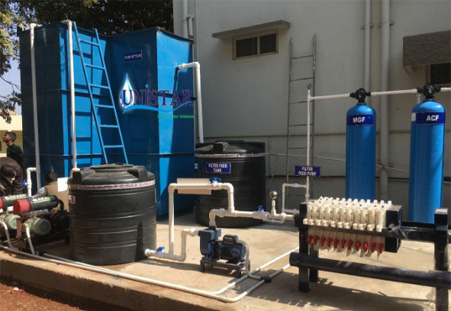
Unistar mostly using equipment branded and high quality under below :-
| SN | ITEMS | DESCRIPTION | QTY | . |
| 1 | Bar Screen | SS304 | 1 | Nos. |
| 2 | Sewage Transfer Pump | Crompton/Kirloskar | 2 | No. |
| 3 | Air Blowers with motor | Akash | 2 | Nos. |
| 4 | Air dispersion system | Universal | 1 | Lot |
| 5 | Sludge Recircultion pump | Crompton/Kirloskar | 1 | Nos. |
| 6 | Filter feed pump | Crompto/Kirloskar | 1 | Nos. |
| 7 | MGF filter | Pentair | 1 | Set |
| 8 | ACF filter | Pentair | 1 | Set |
| 9 | upvc pipe Fittings Astral | Aster, GI (Jindal) | 1 | Lot |
| 10 | FAB Media | Cooldeck / Welcome / Pharmatech | 1 | m3 |
| 11 | Tube deck media | Cooldeck/MM Aqua | 1 | m3 |
| 12 | MSEP Tank | Unistar | 1 | Unit |
| 13 | Filter Press | Unistar | 1 | Unit |
| 14 | Electrical Panel with Cabling | Unistar | 1 | Lot |
| 15 | Chlorine Dosing system | eDose/Unistar | 1 | Set |
| 16 | EM Solution | . | 1 | Set |
Sewage Treatment Plant for Hotels — Price in India
The price of a sewage treatment plant for hotels in India depends on factors such as plant capacity, treatment technology, automation level, installation requirements, and the quality of components used. Small hotel STP systems generally involve a lower investment, while larger plants designed for high wastewater volumes require a higher budget. Cost also varies according to site conditions, customization, and maintenance requirements.
Choosing the right capacity and an efficient treatment process helps hotels manage wastewater effectively while reducing long-term operating expenses. Share your hotel’s occupancy and daily wastewater generation with our team for a solution sized and quoted to your exact requirement.
Additional Information:
- Payment Terms: T/T (Bank Transfer)
- Port of Dispatch: Ghaziabad
- Delivery Time: 30 Days
All Services
Download PDF
Frequently Asked Questions
Many hotels, especially those outside city centers or in developing areas, aren’t connected to a main sewerage system, or local pollution control norms require on-site treatment before any discharge. An STP lets the hotel treat and safely reuse or discharge its own wastewater independently.
MBBR is compact and handles fluctuating loads well, making it popular for hotels with variable occupancy. SBR works well where space allows for batch processing. MBR delivers the highest effluent quality through membrane filtration, suited for hotels wanting to reuse treated water for higher-grade applications. The right choice depends on your hotel’s size, space, and reuse requirements — our team can recommend the best fit.
Space requirements depend on plant capacity and technology chosen. MBBR and package plants are designed to be compact, making them suitable even for hotels with limited available space. Contact us with your daily wastewater volume for a space estimate.
Standard delivery time is around 30 days from order confirmation, with installation and commissioning scheduled separately based on site readiness.
Our systems are designed for continuous operation with minimal maintenance — routine checks on pumps, blowers, and filters, along with periodic sludge removal, are typically sufficient to keep the plant running efficiently.
Yes. Properly treated water meets safe standards for reuse in gardening, flushing, cooling systems, and other non-potable applications — helping hotels cut freshwater consumption and water bills.
We design customized STP solutions for hotels of all sizes — from small boutique properties to large resorts — based on your specific occupancy and wastewater generation.