Water Softener Plant for Residential Building
‘Hard water’ is a common issue in residential buildings, apartments, and housing societies. High levels of calcium and magnesium in the water can lead to the formation of scale in pipelines, bathroom fixtures, water heaters (geysers), washing machines, and other household appliances. Over time, this scale can impede water flow, increase the need for appliance maintenance, and reduce operational efficiency. A water softener plant for residential buildings helps address this problem; it reduces the hardness of the water, making it more suitable for everyday domestic use.
Unistar Aquatech Private Limited provides water treatment solutions designed to meet different residential water requirements. Whether it is an individual apartment building, a multi-storey residential complex or a large housing society, selecting an appropriate water softening system helps maintain consistent water quality across the property.
Water Softener Plant For Residential Building – An Effective Solution for Hard Water
In residential buildings, water is often sourced from borewells, underground reserves, or municipal supplies. Depending on the source, the water may contain dissolved hard minerals that can cause issues during regular use. A residential water treatment system treats this water before it is distributed across various floors and individual residential units.
This system typically operates through an ion-exchange process, in which calcium and magnesium ions—responsible for water hardness—are replaced by sodium ions using a suitable resin. Once the resin reaches its capacity, it is regenerated using a salt solution, allowing the water treatment process to continue.
For apartments and housing societies, an appropriate system can help reduce scaling within the plumbing network, improve washing efficiency, and ensure the smooth operation of water-using appliances.
Why Do Residential Buildings Need a Water Softening System?
Hard water problems are not always immediately visible, but their effects can be noticed in everyday activities. White deposits around taps, reduced performance of water heaters, soap residue and scale formation inside pipelines are some common signs.
Installing a suitable water softening plant can help residential property owners and facility managers address these issues.
- Reduced Scale Formation: Helps minimise calcium and magnesium deposits in pipelines, storage tanks, bathroom fittings and water heaters.
- Better Appliance Performance: Helps protect washing machines, geysers and other appliances from hardness-related scaling.
- Improved Cleaning Results: Softened water allows soap and detergents to work more effectively, reducing soap deposits.
- Lower Maintenance Requirements: Reduces the frequency of descaling and cleaning associated with hard water deposits.
- Suitable for Multiple Flats: Centralised treatment can provide softened water to several apartments through a common distribution system.
All Services
Download PDF
How Does a Residential Water Softener Plant Work?
A residential water softener plant generally uses an ion exchange technology to reduce water hardness. Raw water passes through a vessel containing specialised cation exchange resin. As water moves through the resin bed, hardness-causing calcium and magnesium ions are exchanged with sodium ions.
After treating a certain volume of water, the resin gradually becomes exhausted. The system then undergoes regeneration, during which a concentrated brine solution restores the resin’s softening capacity. The system is subsequently rinsed and made ready for the next operating cycle.
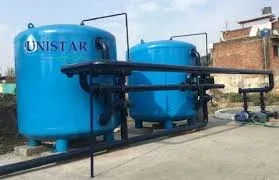
Depending on the installation, the plant may include a resin vessel, brine tank, control valve, supporting piping and other necessary accessories.
Why Choose Unistar Aquatech Private Limited?
Selecting the right water treatment equipment is important for maintaining consistent water quality in residential properties. Unistar Aquatech Private Limited focuses on water treatment solutions designed around the quality of incoming water, treatment requirements and site-specific conditions.
For residential water softening applications, selecting the correct plant capacity, resin arrangement and regeneration system is essential for dependable operation. The company can help customers understand the technical considerations involved in choosing a suitable system for apartments, housing societies and residential complexes.
Whether the requirement is for a new residential project or an existing building experiencing hard water problems, a properly planned water softening solution can help improve water management and reduce hardness-related maintenance concerns.
Frequently Asked Questions
It is a water treatment system that reduces hardness by removing calcium and magnesium ions through an ion exchange process. It is commonly used in apartments, housing societies and residential complexes.
Yes. A centralised water softener plant can be installed in multi-storey residential buildings to treat water before it is distributed to individual apartments.
No. A conventional ion exchange water softener primarily reduces hardness. It does not remove overall dissolved solids in the same way as an RO system.
Capacity depends on daily water consumption, incoming water hardness, peak flow demand and the regeneration frequency required. A water analysis and consumption assessment help determine the appropriate size.
Regeneration frequency depends on raw water hardness, resin capacity and the volume of water treated. Automatic systems can be configured to regenerate based on suitable operating settings.
Yes. Periodic checks of salt levels, control valves, resin performance and the brine system help maintain consistent operation.
Yes. It can be installed in an existing property after assessing the available space, plumbing arrangement, water source and treatment requirements.