Water plays an important role in both residential and industrial applications, but not all water is suitable for direct use. Hard water, which contains high levels of calcium and magnesium ions, can cause scaling, reduce equipment efficiency, and increase maintenance costs. This is where a water softener plant becomes essential. In this detailed guide by Unistar Aquatech Private Limited, we will explain how a water softening plant works, its process, and why it is a smart investment.
What is a Softener Plant?
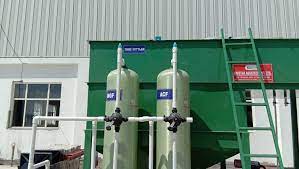
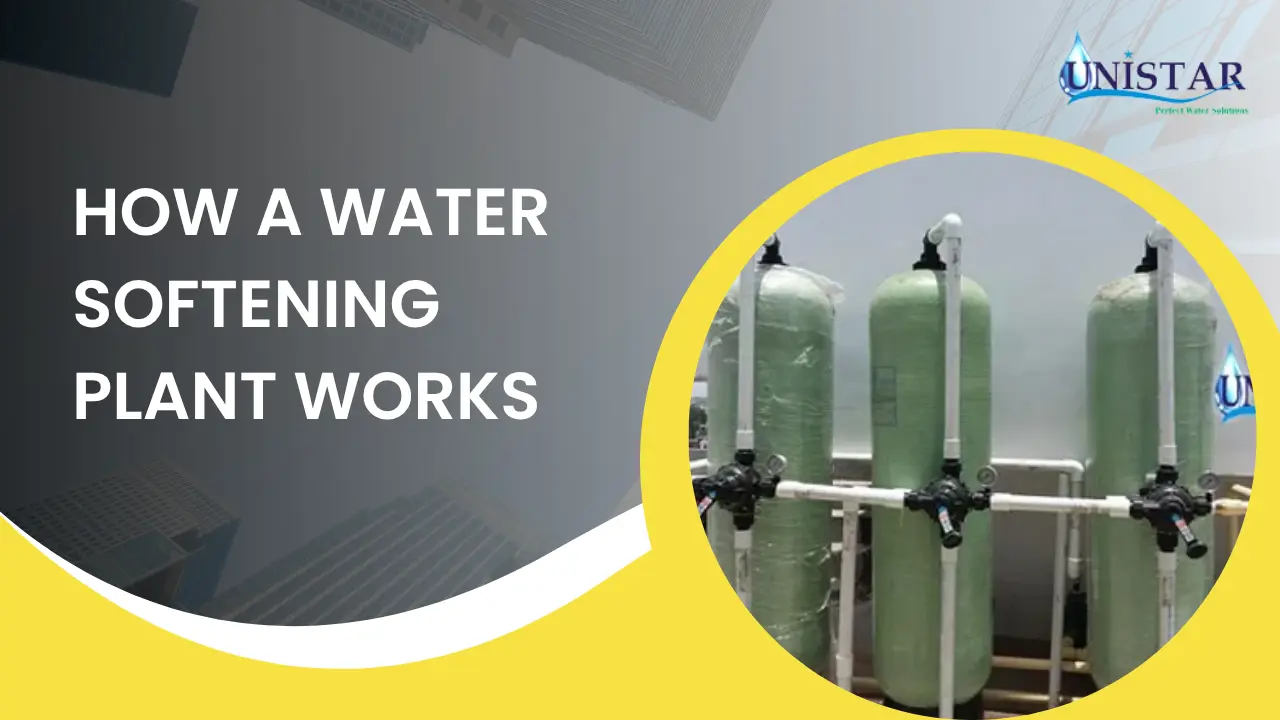
Before diving into the softener plant working, it’s important to understand what a softener plant is. A softener plant is a water treatment system designed to remove hardness-causing minerals like calcium (Ca²⁺) and magnesium (Mg²⁺) from water. The result is soft water that is safe for pipelines, appliances, and industrial machinery. A softening plant is widely used in industries such as pharmaceuticals, textiles, food processing, and also in residential complexes to improve water quality.
Also Read: Industrial Water Treatment Plant Process Step by Step
Why Do You Need a Water Softener Plant?
Hard water can lead to several problems:
- Scaling in pipes and boilers
- Reduced lifespan of appliances
- Increased energy consumption
- Poor soap and detergent efficiency
Installing a water softener plant helps eliminate these issues and ensures smooth operations in both homes and industries.
How Softener Works: Basic Principle
To understand how softener works, you need to know about the ion exchange process. This is the core technology behind every softener plant process. In simple terms:
- Hard water passes through a resin bed.
- The resin contains sodium ions.
- Calcium and magnesium ions in water are exchanged with sodium ions.
- The output is softened water.
This process is efficient, cost-effective, and widely used in modern water softener plant process systems.
Step-by-Step Guide: Softener Plant Working
Let’s break down the softener plant working into clear steps:
Step 1: Hard Water Inlet
The process begins when hard water enters the softener plant through the inlet valve. This water contains dissolved minerals responsible for hardness.
Step 2: Resin Tank (Ion Exchange Process)
The water flows into a resin tank filled with ion exchange resin beads. This is the heart of the softener plant process.
- Resin beads are charged with sodium ions.
- Calcium and magnesium ions attach to the resin.
- Sodium ions are released into the water.
This exchange removes hardness effectively and is the most crucial stage in the water softener plant process.
Step 3: Soft Water Outlet
After passing through the resin bed, the softened water exits the tank and is ready for use. At this stage, the water is free from hardness-causing minerals.
Step 4: Resin Saturation
Over time, the resin beads become saturated with calcium and magnesium ions. This reduces the efficiency of the softener plant working.
Step 5: Regeneration Process
To restore efficiency, the system undergoes regeneration:
- A brine solution (saltwater) is introduced into the resin tank.
- Sodium ions from the brine replace calcium and magnesium ions.
- The hardness minerals are flushed out through a drain.
This regeneration cycle is an essential part of the softener plant process and ensures continuous operation.
Step 6: Rinse and Reuse
After regeneration, the resin is rinsed and ready to soften water again. This cycle repeats automatically in most modern systems.
Types of Water Softener Plants
Different types of water softener plant systems are available based on application:
- Manual Softener Plant – Requires manual operation for regeneration
- Semi-Automatic Softener Plant – Partial automation with manual control
- Fully Automatic Softener Plant – Fully automated system with minimal human intervention
Choosing the right softening plant depends on your water usage and operational needs.
Applications of Softener Plant
A softener plant is used across multiple sectors:
- Residential apartments and housing societies
- Hotels and hospitals
- Textile and dyeing industries
- Pharmaceutical manufacturing
- Food and beverage processing
- Boiler and cooling tower systems
The versatility of the water softener plant makes it an essential component in water treatment solutions.
Benefits of Water Softening Plant
Investing in a water softener plant offers numerous advantages:
- Prevents scaling and corrosion
- Improves efficiency of equipment
- Reduces maintenance costs
- Enhances detergent effectiveness
- Extends the lifespan of appliances
These benefits make the softener plant working highly valuable in both domestic and industrial setups.
Factors Affecting Softener Plant Price
When considering installation, many users ask about softener plant prices. The cost depends on several factors:
- Capacity of the plant
- Type (manual, semi-automatic, automatic)
- Quality of resin and components
- Flow rate and design
- Brand and after-sales support
While the initial softener plant price may vary, the long-term savings on maintenance and energy make it a cost-effective solution.
Maintenance of Softener Plant
Proper maintenance ensures efficient softener plant working:
- Regular salt refilling for regeneration
- Periodic cleaning of resin tank
- Checking valves and pipelines
- Monitoring water quality
A well-maintained softening plant can operate efficiently for many years.
Conclusion
Understanding how a water softening plant works helps you make informed decisions for your water treatment needs. From the ion exchange process to regeneration cycles, every step in the water softener plant process is designed to deliver high-quality soft water.
Whether you are managing an industrial setup or a residential complex, installing a reliable softener plant ensures efficiency, durability, and cost savings. With the right system and proper maintenance, you can enjoy the full benefits of softened water.
If you are planning to invest, consider your requirements carefully and choose a trusted manufacturer like Unistar Aquatech Private Limited for long-lasting performance.