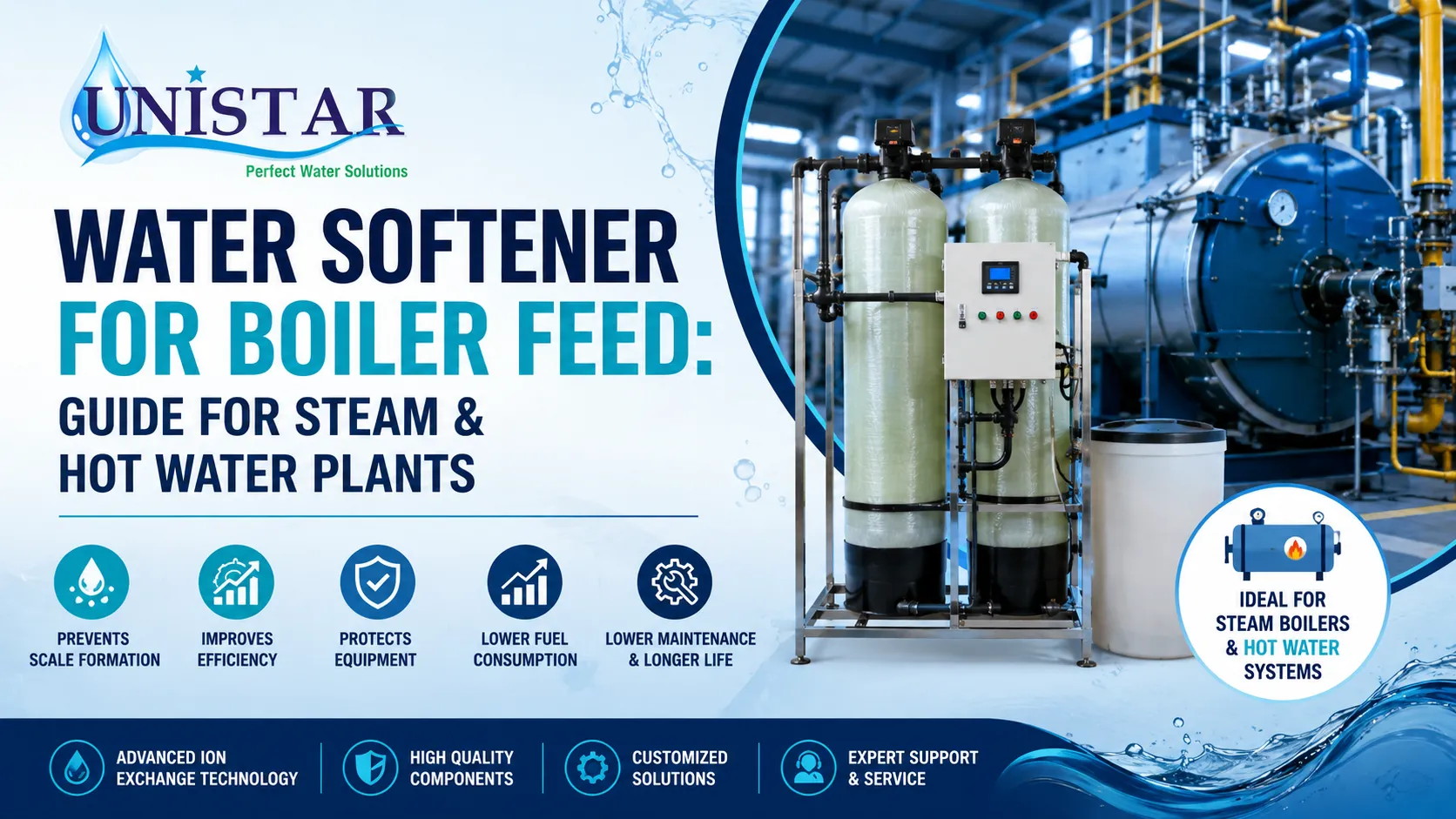
Water quality plays a major role in the performance and service life of steam boilers and hot water systems. When hard water enters a boiler, calcium and magnesium can accumulate on heat-transfer surfaces and form scale. Over time, these deposits can reduce heat-transfer efficiency, increase maintenance requirements, and affect overall plant performance.
This is where a water softener for boiler feed becomes an important part of the water-treatment setup. A properly selected softening system helps reduce hardness before water enters the boiler feed system, supporting cleaner heat-transfer surfaces and more reliable operation.
For industries that depend on continuous steam or hot-water production, treating feedwater is not simply an optional maintenance activity. It is an important part of maintaining consistent plant operation.
Unistar Aquatech Private Limited provides industrial water-treatment solutions, including water softening systems designed for different applications and operating requirements.
What Is a Water Softener for Boiler Feed?
A water softener for boiler feed is a treatment system designed to reduce hardness-causing calcium and magnesium ions from the water used as boiler makeup or feedwater.
Most conventional softeners use an ion-exchange process. Hard water passes through a resin bed containing ion-exchange resin. Calcium and magnesium ions are captured by the resin and exchanged with sodium ions. The resulting water has substantially lower hardness and is better suited for applications where hardness-related scaling needs to be controlled.
The softener is generally installed upstream of the boiler feed system so that incoming makeup water is treated before it reaches the boiler.
However, softening should not automatically be considered a complete boiler-water treatment process. Depending on boiler pressure, steam requirements, feedwater chemistry, and operating conditions, additional treatment such as filtration, RO, deaeration, chemical treatment, or other processes may be required.
Why Is Softening Important for Boiler Feedwater?
The main concern with untreated hard water is scale formation. When hard water is heated inside a boiler, dissolved hardness can precipitate and deposit on heat-transfer surfaces. Even a relatively thin layer of scale can act as an insulating barrier between the heat source and water.
This can make heat transfer less effective and may require the boiler to use more energy to achieve the desired operating conditions. Heavy deposits can also contribute to overheating of heat-transfer surfaces and increase cleaning requirements.
This is why softener boiler water treatment is commonly used as a pretreatment step in industrial boiler systems. By reducing calcium and magnesium hardness before the water reaches the boiler, a softener helps minimize one of the major causes of hardness-related scale.
Also Read: Water Softener for Boiler Feed: Guide for Steam & Hot Water Plants
How Does a Boiler Water Softener Work?
A typical boiler water softener works through several stages.
1. Hard Water Inlet
Raw or makeup water enters the softener system. Its hardness level depends on the source, such as groundwater or municipal supply.
2. Ion Exchange
The water passes through a resin bed. Calcium and magnesium ions attach to the resin while sodium ions are released into the treated water.
3. Soft Water Outlet
After passing through the resin, the treated water leaves the vessel with reduced hardness and can be supplied to the next stage of the boiler feedwater system.
4. Resin Regeneration
The resin eventually becomes loaded with hardness ions and needs regeneration. A concentrated sodium chloride solution, commonly called brine, is passed through the resin to restore its ion-exchange capacity.
5. Rinsing and Return to Service
After regeneration, the resin is rinsed to remove residual brine and displaced hardness. The softener can then return to normal operation. Depending on the application, softeners can be manual, semi-automatic, or fully automatic. Unistar Aquatech offers these configurations as part of its water-softening solutions.
Water Softener for Steam Boiler Applications
A water softener for steam boiler applications is particularly useful where hardness in makeup water could contribute to scale inside boiler heat-transfer areas.
Steam plants continuously lose water through steam production and blowdown, so fresh makeup water may need to be introduced into the system. If this makeup water contains significant hardness, it can introduce calcium and magnesium into the boiler system. Treating makeup water with a suitable softener helps reduce this hardness load.
The actual treatment arrangement should be based on boiler pressure and water chemistry. Low-pressure applications may have different requirements from high-pressure process-steam systems. In applications requiring higher water purity, softening may be followed by additional treatment such as RO or demineralization.
Water Softener for Hot Water Plants
Hot water plants also benefit from controlling water hardness. Although a hot-water system may not produce steam, water is still heated to elevated temperatures. Hardness can therefore contribute to scale on heat exchangers, boilers, pipes, and other heat-transfer equipment.
A water softener for boiler or hot-water application can help reduce hardness entering the system and support more consistent heat-transfer performance. This is particularly relevant for commercial and industrial facilities where hot-water equipment operates for long periods.
Softener Boiler Water Treatment vs Complete Boiler Water Treatment
It is important to understand that softening addresses primarily the hardness component of feedwater.
A complete boiler-water treatment strategy may need to consider several other parameters, including:
- pH
- Total dissolved solids
- Alkalinity
- Silica
- Dissolved oxygen
- Corrosion potential
- Condensate quality
- Boiler operating pressure
- Blowdown requirements
For example, softening does not remove every dissolved substance from water. Therefore, a high-pressure or high-purity steam application may require additional treatment beyond a conventional softener.
The correct solution should be selected after evaluating the source-water analysis and the boiler manufacturer’s requirements.
How to Select the Right Boiler Water Softener?
Choosing a softener simply based on boiler capacity is not enough. Several water-quality and operating parameters should be considered.
Feedwater Hardness
The incoming hardness concentration is one of the most important factors. Higher hardness means greater resin capacity may be required between regeneration cycles.
Required Flow Rate
The softener should be capable of supplying the required water flow without creating excessive pressure drop.
Water Consumption
Daily makeup-water requirements help determine the appropriate resin capacity and regeneration frequency.
Boiler Operating Conditions
The boiler’s operating pressure, steam production, feedwater temperature, and treatment requirements influence the overall water-treatment arrangement.
Automation Level
Automatic systems can simplify regeneration and reduce manual intervention, while manual or semi-automatic systems may be appropriate for certain smaller applications.
Space and Installation Requirements
The available installation area, drainage arrangement, brine tank location, inlet-water pressure, and electrical requirements should also be considered.
Benefits of Using a Water Softener for Boiler Feed
Installing a properly sized softener can provide several operational advantages.
- Reduced hardness-related scaling: Lower calcium and magnesium levels help reduce the potential for hardness scale formation.
- Better heat-transfer conditions: Cleaner heat-transfer surfaces can support more efficient boiler operation.
- Lower maintenance requirements: Reducing scale formation can help minimize the frequency of cleaning associated with hardness deposits.
- Protection of downstream equipment: Treated water can also help protect associated heat exchangers, pipelines, and hot-water equipment.
- More reliable operation: Consistent feedwater quality can support stable plant operation.
- Longer equipment service life: Controlling scale and maintaining appropriate water chemistry can contribute to better long-term equipment performance.
These benefits depend on correct system sizing, proper operation, regeneration, and an overall treatment program appropriate for the specific application.
Industrial Water Boiler Feedwater Treatment
An industrial water boiler system often operates under demanding conditions and may consume significant quantities of makeup water. Industries such as food processing, pharmaceuticals, textiles, chemicals, paper, hospitality, and manufacturing may use boilers for process heating, steam generation, cleaning, or other applications.
For such facilities, water treatment should be planned as part of the complete boiler system rather than as an isolated component.
A softener can serve as an important pretreatment stage, while other equipment may be added depending on the water analysis and steam requirements.
Unistar Aquatech’s industrial water-treatment solutions are designed around application-specific requirements, and the company provides water softening systems for industrial uses including boilers and cooling towers.
Maintenance of a Boiler Feed Water Softener
Regular maintenance is important for maintaining softener performance. Operators should monitor treated-water hardness and observe whether hardness breakthrough is occurring. The brine tank should be maintained properly, valves and control systems should be checked, and regeneration should occur at appropriate intervals.
The resin may also require attention if it becomes fouled by suspended solids, iron, oil, or other contaminants. Proper pretreatment can help protect the resin and maintain its effectiveness.
Keeping records of raw-water hardness, treated-water hardness, regeneration cycles, salt consumption, and water usage can also help operators identify changes in system performance.
Why Choose Unistar Aquatech for Water Softening Solutions?
Unistar Aquatech Private Limited provides water and wastewater treatment solutions for industrial and commercial applications. The company manufactures and supplies water softening plants and other treatment systems, with solutions available in different configurations and customized according to application requirements.
The company has its manufacturing facility in Ghaziabad, Uttar Pradesh, with its corporate office in New Delhi, and serves customers across India.
For boiler applications, the appropriate softener capacity and treatment configuration should be selected after reviewing the source-water quality, hardness, required flow, makeup-water demand, and boiler operating conditions.
Conclusion
A water softener for boiler feed is an important pretreatment solution for controlling calcium and magnesium hardness before water enters steam or hot-water equipment. By reducing hardness, softeners help control scale formation and support better heat-transfer conditions.
Whether the requirement is a water softener for steam boiler, hot-water plant, or industrial process, the system should be correctly sized and integrated with the overall boiler-water treatment strategy.
For low- and medium-demand applications, a properly selected boiler water softener can be an effective way to control hardness. For demanding industrial applications, additional treatment may be necessary depending on feedwater quality and boiler operating conditions.
With application-specific design and appropriate maintenance, Unistar Aquatech can help industries develop a practical water-treatment approach for their boiler and hot-water requirements.