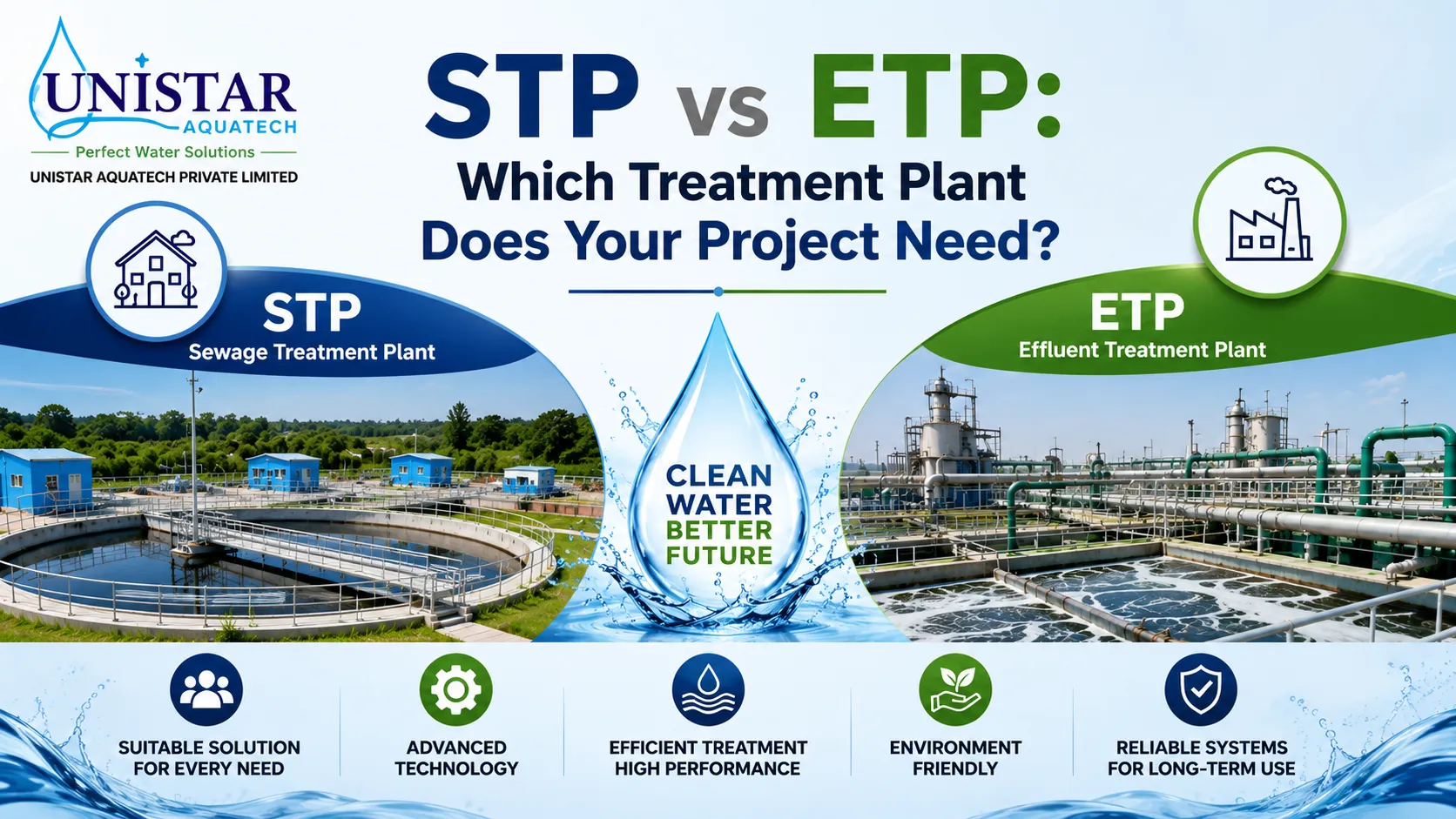
Wastewater treatment is an important part of modern residential, commercial, and industrial projects. However, choosing the right treatment system can be confusing, especially when terms like STP and ETP are used interchangeably. Although both systems are designed to treat wastewater, they are intended for different sources and types of wastewater.
An STP (Sewage Treatment Plant) primarily treats domestic sewage generated from toilets, bathrooms, kitchens, and other household or sanitary activities. An ETP (Effluent Treatment Plant) is designed to treat industrial wastewater, which may contain chemicals, oils, heavy metals, dyes, process residues, or other pollutants.
Understanding the difference between STP and ETP is important before selecting a treatment system. Unistar Aquatech Private Limited provides wastewater and water treatment solutions designed according to the specific requirements of different projects.
What Is an STP?
An STP, or Sewage Treatment Plant, is a wastewater treatment system designed mainly for domestic sewage. The wastewater generally comes from residential societies, apartments, hotels, hospitals, schools, offices, commercial buildings, and similar facilities.
Domestic sewage contains organic matter, suspended solids, nutrients, and microorganisms. An STP uses a combination of physical, biological, and sometimes tertiary treatment processes to reduce these pollutants.
The treated water can potentially be reused for applications such as gardening, flushing, landscaping, or other suitable non-potable purposes, depending on the treatment quality and applicable requirements.
The capacity of an STP depends on factors such as the number of people served, daily water consumption, sewage generation, peak flow, and required treated-water quality.
Also Read: Wastewater Recycling: Benefits for Industries and Commercial Buildings
What Is an ETP?
An ETP, or Effluent Treatment Plant, is designed to treat wastewater generated from industrial processes. Unlike domestic sewage, industrial effluent can have highly variable characteristics depending on the industry and manufacturing process.
For example, wastewater from textile industries may contain dyes and chemicals, while pharmaceutical, chemical, food-processing, metal-finishing, and engineering industries can generate completely different types of effluent.
An ETP is therefore generally designed around the specific characteristics of the industrial wastewater. Treatment may involve processes such as screening, equalization, chemical treatment, biological treatment, clarification, filtration, and other advanced processes depending on the effluent.
The objective is to reduce pollutants to the required levels before discharge, reuse, or further treatment.
STP vs ETP: Key Difference
The biggest difference between an STP and an ETP is the source and characteristics of the wastewater.
| Factor | STP | ETP |
|---|---|---|
| Full Form | Sewage Treatment Plant | Effluent Treatment Plant |
| Main Source | Domestic sewage | Industrial wastewater |
| Typical Users | Residential, commercial and institutional buildings | Manufacturing and industrial facilities |
| Wastewater Characteristics | Relatively predictable | Can vary significantly by industry |
| Main Pollutants | Organic matter, solids and microorganisms | Chemicals, oils, metals, organic pollutants and process contaminants |
| Treatment Design | Based mainly on sewage characteristics and population | Based on industrial process and effluent characteristics |
| Reuse | Gardening, flushing and other suitable applications | Process reuse or other applications depending on treatment quality |
| Customization | Based on capacity and sewage characteristics | Highly dependent on industrial effluent characteristics |
This comparison shows why an STP cannot simply be substituted for an ETP, or vice versa, without evaluating the wastewater source and composition.
When Does Your Project Need an STP?
Your project will generally require an STP when the wastewater is primarily domestic sewage.
Typical projects include:
- Residential societies and apartment complexes
- Hotels and resorts
- Hospitals and healthcare facilities
- Schools and colleges
- Offices and commercial buildings
- Institutions and campuses
- Residential townships
- Airports and similar facilities
For example, if a residential society has hundreds of residents, the wastewater generated from toilets, bathrooms, kitchens, and other domestic activities can be collected and treated through an STP.
The required STP capacity should not be selected simply by guessing the daily wastewater volume. Population, water consumption, occupancy, peak flow, and future requirements should be considered during design.
When Does Your Project Need an ETP?
An ETP is generally required when wastewater is generated from an industrial or manufacturing process.
Industries that may require ETP systems include:
- Textile and dyeing industries
- Pharmaceutical industries
- Chemical manufacturing
- Food-processing industries
- Dairy plants
- Metal-processing industries
- Automobile and engineering industries
- Paper and pulp industries
- Electroplating industries
- Tanneries
- Distilleries
- Other process-based manufacturing units
The treatment process varies significantly from one industry to another. For this reason, an ETP should ideally be designed after understanding the industrial process and analyzing the wastewater.
How to Choose Between STP and ETP?
The first question should be: Where is the wastewater coming from? If the wastewater is mainly domestic sewage from toilets, bathrooms, kitchens, and sanitary facilities, an STP is generally the appropriate treatment solution.
If wastewater is generated from a manufacturing or industrial process, an ETP may be required.
However, some facilities generate both domestic sewage and industrial effluent. In such cases, the two wastewater streams may need to be evaluated separately before deciding on the treatment arrangement.
The wastewater characteristics are particularly important for industrial projects. Parameters such as pH, BOD, COD, TSS, oil and grease, TDS, heavy metals, chemicals, and other industry-specific pollutants can influence ETP design.
STP Treatment Process
A typical STP may include several treatment stages. The exact configuration depends on the required treated-water quality and project conditions. The process can start with screening to remove larger solids. Primary treatment may then help separate settleable solids. Biological treatment is commonly used to reduce biodegradable organic matter.
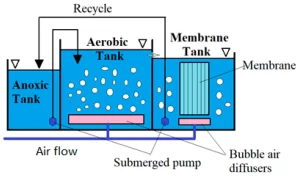
After biological treatment, clarification can separate biological solids from treated water. Depending on the intended reuse or discharge requirements, additional tertiary treatment such as filtration and disinfection may be included. Modern STPs can use technologies such as MBBR, SBR, MBR, or other suitable biological treatment configurations.
ETP Treatment Process
ETP treatment is generally more application-specific. Industrial effluent may first pass through screening and equalization to control flow and wastewater variations.
Depending on the pollutants present, chemical treatment may be required for pH correction, coagulation, flocculation, precipitation, or removal of specific contaminants.
Biological treatment can be added when biodegradable organic pollutants are present. Additional filtration, membrane treatment, evaporation, or other advanced processes may be required for challenging effluents. The final ETP design should be based on wastewater analysis and the required treated-water quality.
Can an STP Treat Industrial Wastewater?
An STP is not automatically suitable for industrial wastewater. Domestic sewage and industrial effluent can have very different compositions. Some industrial wastewater may contain substances that can disturb or damage biological treatment systems designed for domestic sewage. Therefore, simply connecting industrial effluent to an STP without proper assessment can result in poor treatment performance.
If an industrial facility generates both domestic sewage and process wastewater, the two streams should be assessed carefully. In some projects, separate treatment systems may be the more appropriate approach.
Can Treated Water Be Reused?
Both STPs and ETPs can be designed with water reuse in mind, but the possible reuse application depends on the quality of the treated water. Treated STP water may be suitable for non-potable applications such as gardening or toilet flushing when it meets the relevant requirements.
Treated industrial wastewater may potentially be reused for process applications, cooling, washing, or other suitable purposes after achieving the required treatment quality. Additional filtration, disinfection, RO, or other advanced treatment may be required depending on the intended reuse.
Why Choose Unistar Aquatech Private Limited?
Selecting an STP or ETP should be based on the actual wastewater source, flow, characteristics, treatment objectives, and project requirements. A properly selected treatment plant can provide more reliable performance and make future operation and maintenance easier.
Unistar Aquatech Private Limited provides wastewater and water treatment solutions for residential, commercial, institutional, and industrial applications. Our approach focuses on understanding the project requirement before recommending a suitable treatment configuration.
Whether you need an STP for a residential society or an ETP for an industrial facility, the treatment process can be planned according to wastewater characteristics, capacity, treated-water requirements, and available space.
Final Thoughts
The choice between an STP and ETP should never be based only on plant size or price. The most important consideration is the type of wastewater that needs to be treated.
An STP is primarily intended for domestic sewage, while an ETP is designed around industrial effluent and its specific pollutants. Projects generating both types of wastewater may require separate evaluation and treatment arrangements.
Before investing in a treatment plant, it is advisable to assess wastewater quantity, quality, treatment objectives, future requirements, and applicable discharge or reuse requirements. This helps ensure that the selected system is technically suitable and commercially practical for the project.
If you are unsure whether your project requires an STP or ETP, Unistar Aquatech Private Limited can help evaluate your wastewater treatment requirement and recommend a suitable solution.