Clean and safe water is essential for industries, communities, and the environment. As water treatment requirements become more demanding, conventional filtration methods alone may not always provide the desired level of purification. This is where membrane filtration has become an important technology.
But what exactly is membrane filtration, how does it work, and where is it used? In simple terms, membrane filtration is a separation process that uses a specially designed barrier to remove unwanted particles, microorganisms, dissolved substances, and other contaminants from a liquid.
Modern membrane systems are widely used in drinking water treatment, wastewater treatment, industrial process water, food and beverage production, pharmaceuticals, and many other applications.
Also Read: Water Softener for Boiler Feed: Guide for Steam & Hot Water Plants
What Is Membrane Filtration?
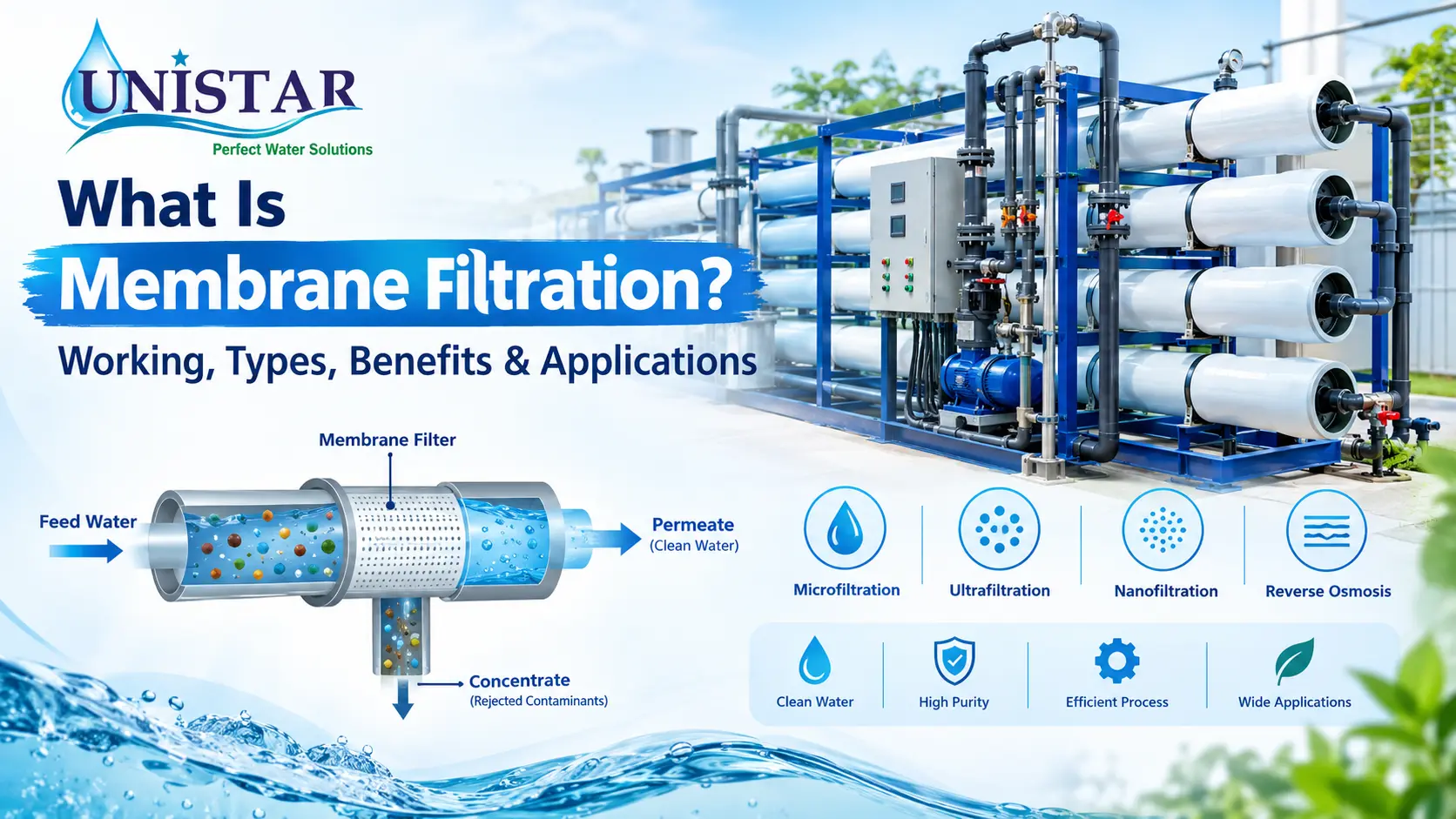
Membrane filtration is a pressure-driven separation process in which water or another liquid passes through a semi-permeable membrane. The membrane contains extremely small pores or has a selective structure that allows certain substances to pass while retaining others.
The liquid that passes through the membrane is generally called permeate, while the concentrated stream containing retained contaminants is called retentate or concentrate.
The performance of a system depends on factors such as membrane material, pore size, operating pressure, feed-water quality, temperature, and the type of contaminants that need to be removed.
A membrane filter can therefore be selected according to the specific treatment requirement rather than using the same filtration method for every application.
How Does Membrane Filtration Work?
The basic working principle of membrane filtration is relatively simple.
First, the feed water enters the membrane filtration system. A pump creates the pressure required to push the water toward the filtration membrane. As the water moves across the membrane surface, contaminants larger than the membrane’s separation capability are retained.
The treated water passes through the membrane and becomes the permeate. The rejected contaminants remain in the concentrate stream.
Depending on the type of membrane technology being used, the system can remove suspended solids, bacteria, viruses, colloidal particles, organic compounds, dissolved salts, and other impurities.
A typical process can be understood as:
Feed Water → Pre-Treatment → Pressure Pump → Membrane Unit → Permeate + Concentrate
This basic arrangement can be expanded with cleaning systems, monitoring instruments, storage tanks, and post-treatment equipment depending on the application.
Membrane Filtration Diagram: Understanding the Process
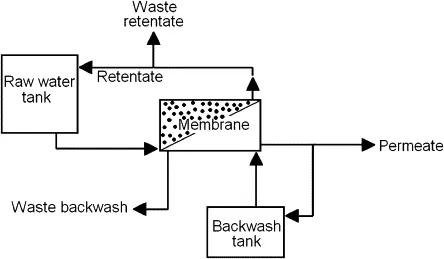
A membrane filtration diagram generally shows the movement of feed water through a membrane module and the separation of the incoming stream into permeate and concentrate.
For example:
Feed Water → Pump → Membrane Module → Permeate
** ↓**
** Concentrate**
A detailed membrane filter diagram may also include pre-filtration, chemical dosing, pressure gauges, flow meters, cleaning arrangements, and permeate collection.
The exact configuration varies depending on whether the system uses microfiltration, ultrafiltration, nanofiltration, or reverse osmosis.
Types of Membrane Filtration
Different membrane technologies provide different levels of separation. The four commonly used categories are:
1. Microfiltration
Microfiltration uses membranes with relatively larger pores compared with other membrane technologies. It is mainly used to remove suspended solids, bacteria, algae, and larger microorganisms.
It is commonly used as a pre-treatment step and in applications where fine particle removal is required.
2. Ultrafiltration
Ultrafiltration has smaller pores than microfiltration. It can remove fine suspended solids, colloids, bacteria, and many viruses.
UF systems are widely used in water purification and wastewater treatment because they can produce high-quality filtered water without requiring extremely high operating pressure.
3. Nanofiltration
Nanofiltration provides finer separation than ultrafiltration. It can reduce certain dissolved organic compounds, hardness-causing substances, and selected ions.
NF is useful when water requires more treatment than UF but does not necessarily require the high salt rejection associated with reverse osmosis.
4. Reverse Osmosis
Reverse osmosis, commonly known as RO, uses a very dense membrane to remove dissolved salts, minerals, and many other dissolved contaminants.
RO is widely used for drinking water purification, industrial process water, desalination, boiler-feed water, and other applications requiring high-purity water.
What Is a Filtration Membrane Made Of?
A filtration membrane can be manufactured from different materials depending on its intended application. Common membrane materials include polymeric materials and, in specialized applications, ceramic materials.
The choice of material affects chemical resistance, mechanical strength, temperature tolerance, cleaning requirements, and membrane life.
The membrane is generally installed inside a module so that a larger membrane surface can be provided within a compact system.
What Is a Membrane Filtration Unit?
A membrane filtration unit is the complete equipment arrangement used to perform membrane-based separation. It normally includes the membrane modules along with pumps, valves, piping, pressure controls, instruments, and other supporting components.
Depending on the application, a membrane filtration unit may also include:
- Feed pumps
- Pre-treatment filters
- Membrane modules
- Pressure gauges
- Flow meters
- Control valves
- Chemical dosing systems
- Cleaning-in-place arrangements
- Permeate collection system
- Concentrate discharge system
The configuration is normally customized according to water quality, required flow rate, treatment objective, and desired output quality.
Benefits of Membrane Filtration
Membrane filtration has become popular because it provides several practical advantages.
High-Quality Separation
Membrane technology can provide consistent separation of particles and contaminants when the system is properly designed and operated.
Compact Equipment
Compared with some conventional treatment processes, membrane systems can provide high treatment capacity within a relatively compact footprint.
Flexible Operation
Different membrane technologies can be selected depending on the required level of purification.
Reduced Chemical Requirement
Certain membrane filtration processes can operate with fewer chemicals than some conventional treatment methods, although cleaning chemicals or pre-treatment chemicals may still be required.
Easy Process Integration
Membrane systems can be combined with conventional filtration, biological treatment, RO, disinfection, and other water-treatment technologies.
Suitable for Water Reuse
Membrane technology can help produce treated water suitable for various reuse applications, depending on the treatment process and water-quality requirements.
Applications of Membrane Filtration
Membrane filtration is used across a wide range of industries and treatment facilities.
Some common applications include:
- Drinking water purification
- Industrial wastewater treatment
- Municipal wastewater treatment
- Effluent treatment plants
- Sewage treatment systems
- Process water treatment
- Food and beverage industries
- Pharmaceutical manufacturing
- Chemical industries
- Dairy processing
- Water recycling and reuse
- Desalination
- Boiler-feed water treatment
In industrial facilities, membrane technology can also be combined with other treatment stages to achieve specific water-quality targets.
Membrane Filtration vs Conventional Filtration
Conventional filtration generally relies on media such as sand, gravel, activated carbon, or other filtering materials to remove contaminants. Membrane filtration uses a selective membrane barrier for separation.
The two technologies do not necessarily compete with each other. In many modern treatment plants, they work together. Conventional filtration may be used as pre-treatment to reduce the contaminant load before water enters a membrane system.
This combination can improve membrane performance and help reduce fouling.
Factors to Consider Before Selecting a Membrane System
Choosing the right membrane system requires more than simply selecting a membrane based on its pore size. Important factors include:
- Feed-water characteristics
- Required treatment capacity
- Type of contaminants
- Desired permeate quality
- Operating pressure
- Temperature
- Membrane material
- Cleaning requirements
- Energy consumption
- Concentrate disposal requirements
A proper technical assessment can help determine whether MF, UF, NF, RO, or a combination of technologies is appropriate.
Why Choose Unistar Aquatech Private Limited?
Unistar Aquatech Private Limited provides water and wastewater treatment solutions designed around specific industrial and commercial requirements.
For projects involving membrane filtration, selecting the right process configuration is important for achieving reliable treatment performance. Factors such as feed-water quality, flow rate, treatment objectives, and downstream requirements need to be considered during system planning.
A well-designed membrane system can become an important part of a complete water-treatment or wastewater-treatment plant, particularly where high-quality filtration, water recovery, and reuse are required.
Conclusion
Membrane filtration is an efficient and versatile technology for separating unwanted substances from water and other liquids. From microfiltration and ultrafiltration to nanofiltration and reverse osmosis, different membrane technologies can address different purification requirements.
Understanding the role of the membrane filter, filtration membrane, and complete membrane filtration unit makes it easier to select the right treatment approach. With proper pre-treatment, operation, cleaning, and maintenance, membrane systems can provide reliable performance across numerous industries.
For organizations planning a water purification, wastewater treatment, or water-reuse project, membrane filtration can be an effective technology when selected and engineered according to the actual treatment requirements.