Our homes, offices, schools, and industries generate large amounts of sewage every day. Discharging this wastewater into rivers, lakes, or the ground without proper treatment not only harms the environment but also poses a threat to human and animal health. For this reason, sewage waste water treatment has become a crucial process today. The purpose of this process is to clean wastewater and make it reusable.
What is Sewage Treatment?
Sewage treatment is a scientific process that removes harmful elements, chemicals, solids, and bacteria from wastewater. This process produces clean water that can be reused for agriculture, industry, or other non-potable purposes. Companies like Unistar Aquatech Private Limited use modern technologies to design and install sewage treatment plants that operate at high efficiency in a small space.
Also Read: Reverse Osmosis RO Plant
Sewage Water Treatment Process
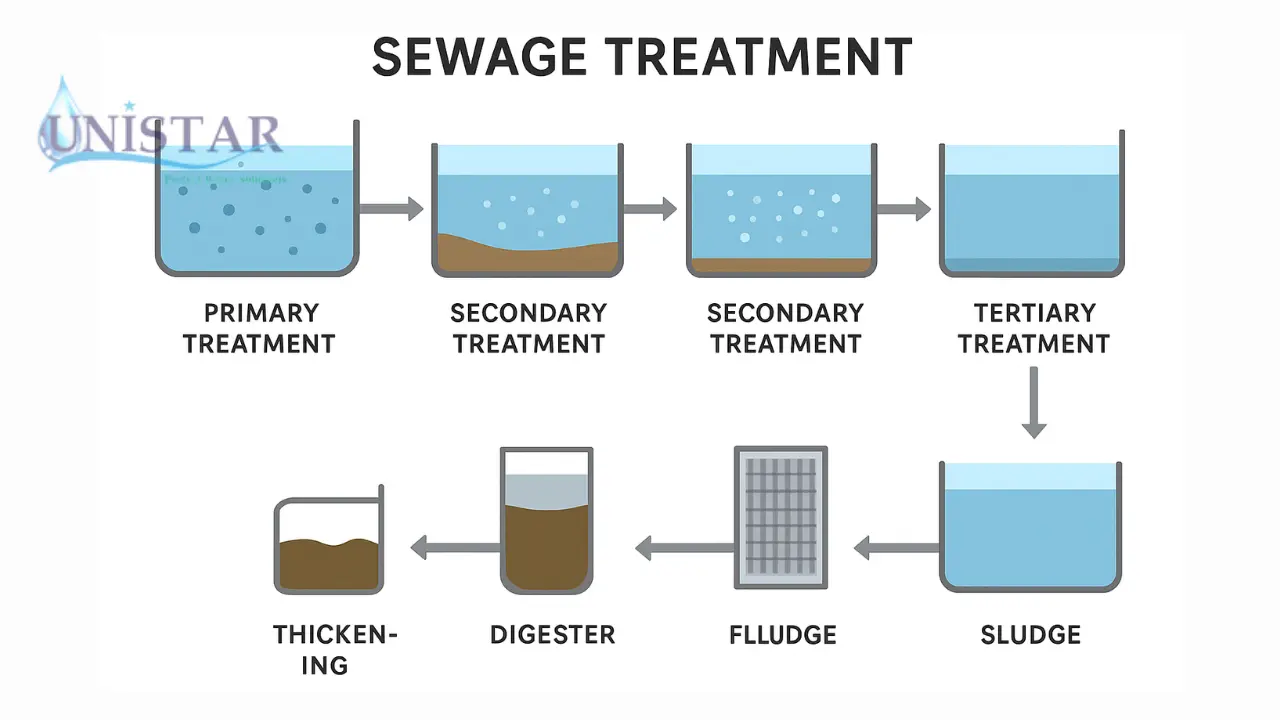
The sewage water treatment process primarily consists of three stages:
Primary Treatment
This stage involves separating large solids such as textiles, plastics, sand, and debris from the water. Screening, grit chambers, and sedimentation tanks are used for this purpose. This removes up to 40% of the solid waste from the water.
Secondary Treatment
This stage is called biological treatment. In this process, soluble organic matter in the water is broken down using bacteria and microorganisms. Techniques such as the Activated Sludge Process, Trickling Filter, or Bio-tower System are used.
Tertiary Treatment
This is the most advanced stage in which the water is completely purified so that it can be reused. Chlorination, UV disinfection, and filtration systems are used. After this entire process, the water becomes so clean that it can be safely used in activities like farming, industrial cooling, and toilet flushing.
What are Sewage Treatment Plants?
A sewage treatment plant (STP) is a machinery or system where this entire purification process is carried out. This plant recycles wastewater and makes it environmentally friendly. Unistar Aquatech Private Limited manufactures sewage water treatment plants based on advanced technology that are robust, efficient, and energy-efficient.
Methods of Sewage Disposal
There are several methods for safely disposing of sewage disposal methods. Let’s take a closer look at these.
Land Application: The treated water is used for irrigation and agricultural purposes. This saves water and also helps in crop growth.
- Dilution: The treated water is released into rivers or lakes in controlled quantities so that it does not cause pollution.
- Recycling: The treated water is reused in industries, factories, or buildings for cleaning, cooling towers, or toilet flushing.
- Composting: Sewage sludge is dried and converted into organic fertilizer, which is useful for agriculture.
By adopting all these methods of disposing sewage, we can not only protect the environment but also contribute to water conservation.
Advantages of Sewage Water Treatment
- Environmental pollution is reduced.
- Natural water sources are protected.
- Clean water becomes reusable.
- Public health has improved.
- Water is saved in industrial areas.
sewage treatment faces some challenges. Such as: High installation costs, Requirement for regular maintenance, Requirement for trained staff. But Unistar Aquatech Private Limited addresses all these challenges with modern designs and automated systems. The company’s sewage water treatment plants are long-lasting and energy-efficient.
Conclusion
In today’s world, sewage water treatment is not just an option but a responsibility. With a growing population and urbanization, we must understand the importance of every drop of water. Unistar Aquatech Private Limited provides efficient wastewater treatment processes using cutting-edge technologies that promote both environmental protection and water reuse. By adopting the right sewage disposal methods, we can leave a clean and safe environment for future generations.