Rapid urbanization, industrial development and increasing population have made effective wastewater management essential for residential, commercial and industrial facilities. Untreated sewage contains organic matter, suspended solids, nutrients and microorganisms that can negatively affect the environment and public health. A properly designed sewage treatment system helps remove these contaminants and produces treated water suitable for reuse or safe discharge as per applicable requirements.
There are different types of sewage treatment plants available depending on sewage characteristics, treatment capacity, available space, required treated-water quality and the intended application. Selecting the right system is important for achieving reliable treatment performance and controlling operating costs.
Unistar Aquatech Private Limited provides engineered wastewater and sewage treatment solutions for different capacities and applications. From compact systems for smaller facilities to large-capacity municipal installations, the treatment process can be designed according to the project’s specific requirements.
What Is a Sewage Treatment Plant?
A Sewage Treatment Plant (STP) is a treatment system designed to remove pollutants and contaminants from domestic or municipal sewage. The treatment process generally involves physical, biological and, where required, tertiary treatment stages.
The main objective of an STP is to reduce parameters such as Biochemical Oxygen Demand (BOD), Chemical Oxygen Demand (COD), Total Suspended Solids (TSS), nutrients and harmful microorganisms before the treated water is reused or discharged.
The selection of an appropriate type of STP depends on factors such as sewage flow, influent characteristics, treatment standards, land availability, automation requirements and the final use of treated water.
Also Read: Sewage Treatment Plant (STP): Definition, Process, Advantages & Disadvantages
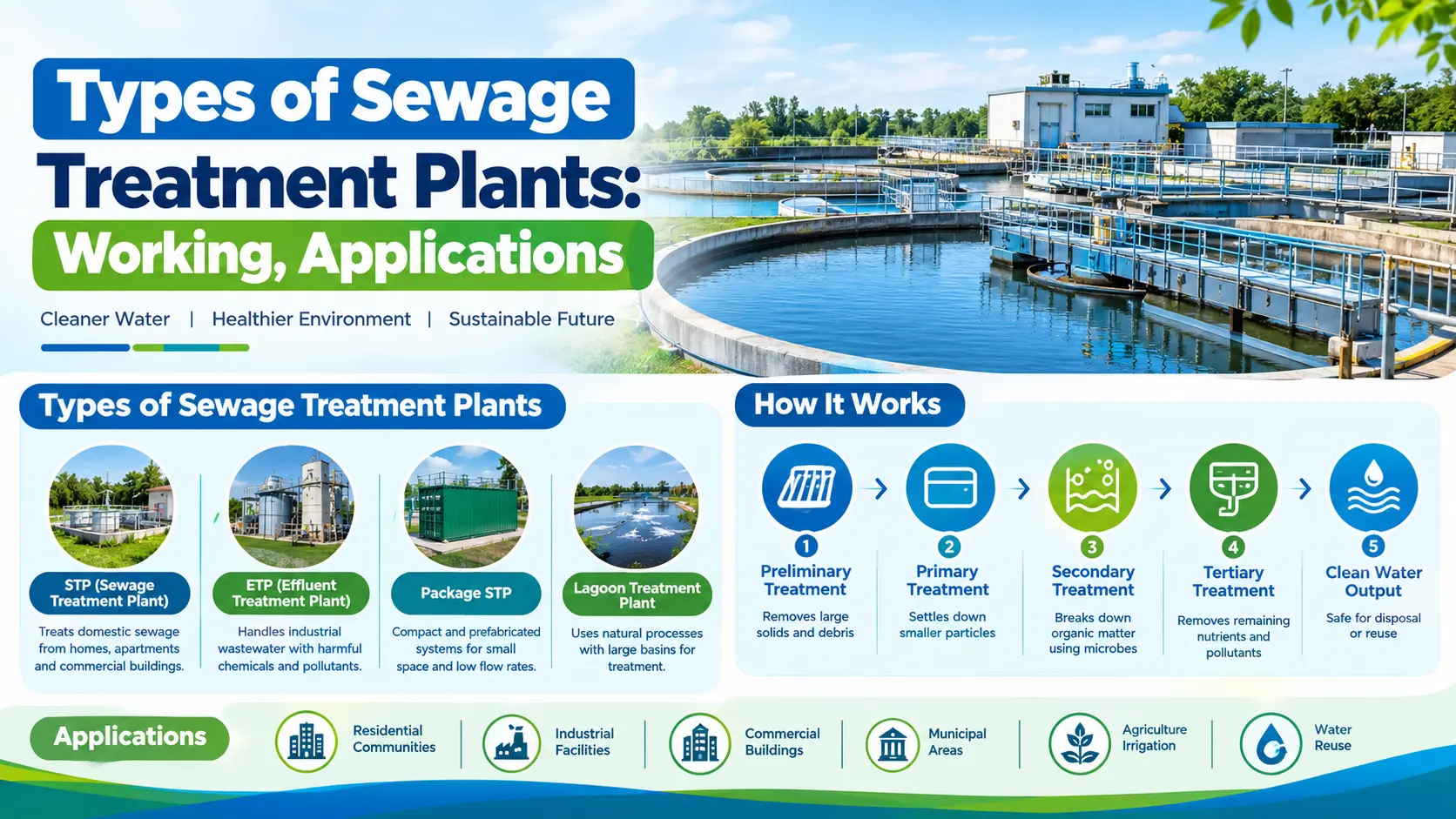
How do Sewage Treatment Plants Work Flow Diagram?
Types of Sewage Treatment Plants
There are several technologies used in modern sewage treatment systems. The major STP plant types include conventional activated sludge systems, SBR, MBBR, MBR, extended aeration and other biological treatment processes.
1. SBR Sewage Treatment Plant
Sequencing Batch Reactor (SBR) is a biological treatment process in which different treatment stages take place sequentially within the same reactor.
A typical SBR cycle includes filling, aeration, settling, decanting and sludge wasting. Because these processes are carried out in a controlled sequence, separate aeration and secondary clarification tanks may not always be required.
SBR systems are commonly considered for residential complexes, institutions, hotels, commercial buildings and municipal applications where automation and consistent treatment performance are important.
2. MBBR Sewage Treatment Plant
Moving Bed Biofilm Reactor (MBBR) technology uses specially designed carrier media inside an aeration tank. Microorganisms grow on the surface of these media and help break down organic pollutants present in sewage.
Continuous aeration keeps the media moving and provides oxygen required for biological treatment. MBBR systems can provide good treatment performance in a relatively compact footprint.
They are suitable for apartments, hotels, hospitals, institutions, industries and commercial facilities where space and treatment efficiency are important considerations.
3. MBR Sewage Treatment Plant
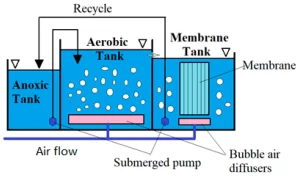
Membrane Bioreactor (MBR) technology combines biological treatment with membrane filtration. The membrane separates treated water from biological solids, producing high-quality treated water.
MBR systems are particularly useful where treated water is intended for applications such as toilet flushing, landscaping, cooling or other non-potable reuse requirements.
The technology can offer a compact footprint and high-quality effluent, although membrane maintenance and operating costs need to be considered during system selection.
4. Extended Aeration STP
Extended aeration is a modified activated sludge process in which sewage remains in the biological treatment system for a comparatively longer period.
The extended aeration process allows microorganisms to consume organic matter under controlled aeration conditions. It is often used for residential societies, institutions, hotels and commercial establishments.
This technology can be considered where reliable biological treatment and relatively simple operation are required.
5. Conventional Activated Sludge Treatment
The activated sludge process is one of the established biological wastewater treatment methods. In this process, microorganisms are supplied with oxygen in an aeration tank to consume biodegradable organic matter.
After biological treatment, the mixed liquor enters a settling stage where biological solids are separated from treated water. A portion of the settled sludge can be recycled back into the aeration tank to maintain the required microbial population.
The process is widely applicable to municipal and large-scale sewage treatment facilities.
How Does an STP Work?
Although treatment processes differ according to technology, most sewage treatment systems include several fundamental stages.
Preliminary Treatment
The incoming sewage first passes through screening equipment that removes large floating materials such as plastics, rags and other debris. Grit removal may also be provided to protect downstream equipment from abrasion and blockage.
Primary Treatment
In primary treatment, heavier suspended solids settle under controlled conditions. This reduces the solids load entering the biological treatment section.
Biological Treatment
The biological stage is the core of many types of STP plant technologies. Microorganisms consume biodegradable organic matter present in sewage.
Depending on the selected technology, biological treatment may use suspended-growth microorganisms, attached-growth media or membrane-based separation.
Secondary Clarification or Membrane Separation
After biological treatment, solids are separated from treated water. Conventional systems may use secondary clarifiers, while MBR systems use membranes for solid-liquid separation.
Tertiary Treatment and Disinfection
Additional filtration, nutrient removal and disinfection may be incorporated when higher-quality treated water is required. UV or chemical disinfection can be used depending on the application and design requirements.
The final treated water can then be directed towards reuse or compliant discharge.
Sewage Treatment Plant Components
The exact equipment arrangement depends on the selected technology and project capacity. However, common sewage treatment plant components may include:
- Bar screens or mechanical screening systems
- Grit removal equipment
- Equalization tank
- Primary settling system
- Aeration tank or biological reactor
- MBBR media, where applicable
- Air blowers and diffusers
- Secondary clarifier, where applicable
- Membrane modules for MBR systems
- Sludge handling system
- Filter system
- Disinfection unit
- Treated water storage tank
- Pumps and piping
- Electrical control panel and automation system
A properly engineered equipment configuration helps maintain stable treatment performance while simplifying operation and maintenance.
Applications of Sewage Treatment Plants
Modern sewage treatment systems are used across a wide range of sectors. Common applications include residential societies, municipalities, hotels, hospitals, schools, colleges, shopping complexes, commercial buildings, industrial campuses and infrastructure projects.
The treated water can potentially be reused for gardening, toilet flushing, floor washing, cooling and other suitable non-potable applications, depending on the treatment quality and applicable requirements.
For large developments, selecting the correct capacity is particularly important because an undersized plant may struggle during peak flows, while an unnecessarily oversized system can increase capital and operating costs.
50 MLD Sewage Treatment Plant
A 50 MLD sewage treatment plant is designed for large-scale sewage treatment requirements where the expected flow is around 50 million litres per day. Such systems are generally relevant to major urban developments, municipalities and large infrastructure projects.
At this scale, STP design requires detailed evaluation of average and peak sewage flow, influent characteristics, treatment standards, sludge management, hydraulic profile, energy consumption and automation requirements.
The selected technology should therefore be based on a detailed engineering assessment rather than capacity alone.
60 MLD Sewage Treatment Plant
A 60 MLD sewage treatment plant is another large-capacity solution intended for high-volume municipal or infrastructure applications. A plant of this scale requires careful planning of inlet works, biological treatment, clarification or membrane separation, sludge management and treated-water handling.
For large projects, redundancy and operational flexibility are also important. Properly designed treatment units can help maintain plant performance during maintenance periods and varying sewage loads.
Unistar Aquatech can develop sewage treatment solutions according to project capacity, sewage characteristics, site conditions and the intended treated-water application.
How to Choose the Right STP Plant Type?
Choosing among different types of sewage treatment plant technologies requires consideration of several factors:
- Sewage Flow: Determine average, peak and future projected flow rather than selecting a plant only according to current consumption.
- Influent Quality: BOD, COD, TSS, nitrogen, phosphorus and other parameters influence the treatment process.
- Available Space: Compact technologies such as MBR or certain MBBR configurations may be preferable where land availability is limited.
- Treated Water Requirement: If water reuse is planned, additional filtration and disinfection may be necessary.
- Operating Cost: Energy consumption, chemical requirements, membrane replacement and sludge management should be evaluated.
- Automation: Large or continuously operated facilities may benefit from automated monitoring and control systems.
Why Choose Unistar Aquatech Private Limited?
Unistar Aquatech Private Limited focuses on engineered water and wastewater treatment solutions designed around the requirements of individual projects. Instead of applying the same configuration to every site, the treatment technology and equipment arrangement can be selected according to flow, sewage characteristics, space availability and treated-water requirements.
For commercial facilities, residential developments and large municipal projects, choosing the right STP technology can improve treatment reliability, water reuse potential and long-term operational efficiency.
Whether the requirement is a compact biological treatment system or a large-capacity 60 MLD sewage treatment plant or 50 MLD sewage treatment plant, proper engineering and technology selection are essential for achieving dependable results.
Conclusion
Understanding the different types of STP plant technologies makes it easier to select a treatment solution suited to a project’s actual requirements. SBR, MBBR, MBR, extended aeration and conventional activated sludge systems each have different operating principles, advantages and applications.
The right choice depends on sewage flow, influent quality, available space, treated-water standards, reuse requirements and lifecycle cost. With appropriate sewage treatment plant components, process design and automation, an STP can provide reliable treatment while supporting responsible water management.
For customized sewage treatment requirements, Unistar Aquatech Private Limited can help evaluate the project and identify a suitable STP configuration based on capacity, application and treatment objectives.